
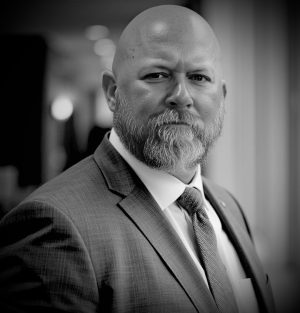
Rich Creamer is a US Navy veteran and retired Sergeant with the Norfolk Police Department, bringing 25 years of combined military and law enforcement service forged on the front lines of public safety. His career began patrolling some of Norfolk’s most crime-ridden neighborhoods and evolved through elite specialized assignments including the Gang Unit, Homicide, FBI Violent Crime Task Force, Cold Case Homicide, Training Division, and Criminal Intelligence Unit. Over the course of his career, Rich earned Officer of the Year, two U.S. Attorney Public Service Awards, and multiple departmental commendations.
In his final assignment with the Training Division, Rich oversaw the development and instruction of Critical Incident Stress Management (CISM) and Peer Support programming — providing direct support and training to Norfolk PD and emergency service agencies across the region. He didn’t just train others. He built the systems from the ground up.
Over the past decade, Rich has worked at the forefront of public safety wellness. As founder of the Norfolk Public Safety Wellness Initiative, he launched Virginia’s first facility-dog program, a state-of-the-art functional fitness facility, and holistic wellness partnerships providing float therapy, infrared sauna, massage therapy, and nutrition counseling — all at no cost to public-safety personnel.
Rich continues to shape the future of first responder wellness as the Director of Public Safety Insights for Lighthouse Health & Wellness, Advisory Board Member for Survive First, Public Safety Liaison for Mutts with a Mission, and Board Member and Trainer for Blue Cancer Connect. He also serves as a Consultant and Family Wellness Co-Chair with the International Association of Chiefs of Police (IACP) Collaborative Reform Initiative – Technical Assistance Center for Officer Wellness.
Today, Rich is the host of the Responder Reset Podcast, a keynote speaker, and an action-oriented advocate for authentic, peer-driven culture change in public-safety wellness. His message is clear: the profession doesn’t need more awareness — it needs action.
He holds a Bachelor of Arts in Sociology from Old Dominion University and a Master of Arts in Human Services Counseling from Liberty University.
- Accountability in Wellness
- Family Silence & Peer Support
- Leadership Culture
- Organizational Betrayal
- Peer-Driven Culture Change
- Complacency in Public Safety
- Trauma & Resilience
- Identity Beyond the Badge
Carry What It Gave You
This keynote begins before the badge and before the uniform. Rich traces a life of adversity — the personal struggles, hardships, and defining moments that didn’t just shape who he became, but drove him toward military service and a career in law enforcement in the first place. For many who serve, the path to the profession is itself a story of survival.
From those roots, Rich confronts the full reality of a career in service — what the job takes, what it gives, and what remains when the uniform, rank, or title no longer defines your identity. It addresses accountability, transition, leadership responsibility, and the long-term weight carried by those who serve.
This is not a feel-good talk. It’s an honest one.
BEST FOR: COMMAND STAFF · PEER TEAMS · TRANSITION PROGRAMS · VETERAN AUDIENCES
KEY POINTS
THE TRUE COST OF SERVICE
A candid look at what careers in public safety and the military extract from people — not just physically, but psychologically, relationally, and in terms of identity — and why that cost is rarely acknowledged until it becomes a crisis.
IDENTITY BEYOND THE BADGE
When rank, role, and routine disappear — through retirement, transition, or injury — who remains? Rich confronts the identity void that ends careers far more often than it should, and what leaders must do to prepare their people for it.
ACCOUNTABILITY, NOT AWARENESS
Acknowledging a problem is not the same as solving it. Rich challenges leaders and peers to move beyond performative support and own their role in building cultures where people actually ask for help — and actually receive it.
LEADERSHIP RESPONSIBILITY IN WELLNESS
Supervisors and commanders set the conditions for either silence or support. Rich outlines what authentic leadership responsibility looks like in practice — inside the precinct, the firehouse, and beyond.
CARRYING IT FORWARD WITH INTENTION
The weight of service doesn’t disappear at retirement. Rich shows audiences how to transform that weight — not into burden, but into purpose — building the next chapter with the same commitment they brought to the first.
The Seven Deadly Sins of Public Safety Wellness
A direct, unflinching examination of why well-intentioned wellness efforts fail — and why they keep failing. Rich draws from seven deadly sins that plague public safety wellness, focusing on four that cut the deepest: performative wellness, family silence, organizational betrayal, and complacency. But this keynote doesn’t stop at the diagnosis. For each major barrier, Rich provides actionable resets — practical, honest strategies that give individuals, peer teams, and leaders a clear path forward. No sugarcoating. No platitudes. Just accountability and a plan.
BEST FOR: CHIEFS · HR LEADERS · WELLNESS COORDINATORS · PEER TEAMS · AGENCY LEADERSHIP
KEY POINTS
PERFORMATIVE WELLNESS
Flyers, t-shirts, and awareness months aren’t programs. Rich calls out the gap between looking like you care about wellness and actually building infrastructure that supports people in need — and explains why the distinction costs lives.
FAMILY SILENCE
The home is where the job follows first responders when the shift ends. Rich confronts the culture of silence that prevents spouses, children, and families from naming what they’re experiencing — and how that silence, left unaddressed, fractures the very relationships that keep responders grounded. Families are not peripheral to wellness; they are central to it.
ORGANIZATIONAL BETRAYAL
When the institution a responder gave everything to fails to show up in their moment of need, the damage goes far deeper than disappointment. Rich addresses the breach of trust that occurs when organizations prioritize liability, optics, or politics over the people who served them — and what it takes to rebuild credibility once that trust is broken.
COMPLACENCY
Complacency may be the most dangerous sin of all — the slow drift that happens when organizations convince themselves that good enough is working. Rich challenges leaders and peer teams to recognize complacency for what it is: not stability, but stagnation. The absence of crisis is not the presence of wellness.
I really appreciated your presentation as the wife of a LEO and Mother in Law of another, so much of what you said resonated with me. I’ve worked in the psychiatric field for over 30 years and am thankful for your raw and real fund of knowledge and perspective.